
Top ZY-MW Multi-Wire Saw Models for Slab Stone Cutting: A Ranked Picks List
A stone processing plant that has already decided to buy a slab stone cutting machine usually reaches the same bottleneck: the supplier offers a family of wire counts, and the gap between a 72-wire and an 86-wire configuration is not a detail. Wire count is fixed at order together with the frame structure, the tension system and the machine weight class, and it sets how many slabs come out of each block cycle. This article ranks representative models from the Stonewin ZY-MW multi-wire saw series — the range that runs from ZY-MW5 to ZY-MW90 and covers 5 to 90 wires — by wire count position and by practical application fit for high-volume marble and granite slab cutting, with ZY-MW72 and ZY-MW86 examined in the most detail.
Quick Answer
- Series and model range: ZY-MW multi-wire saw series, from ZY-MW5 to ZY-MW90
- Wire count: 5 to 90 wires
- Tension configuration: side-tension or top-tension options
- Slab cutting envelope: 3500 mm × 2200 mm
- Machine weight: 22 to 80 tons, depending on configuration
- Ranked #1 for high-volume slab throughput: ZY-MW86
- Ranked #2, marble-first flexibility: ZY-MW72
- Highest wire count in the range: ZY-MW90

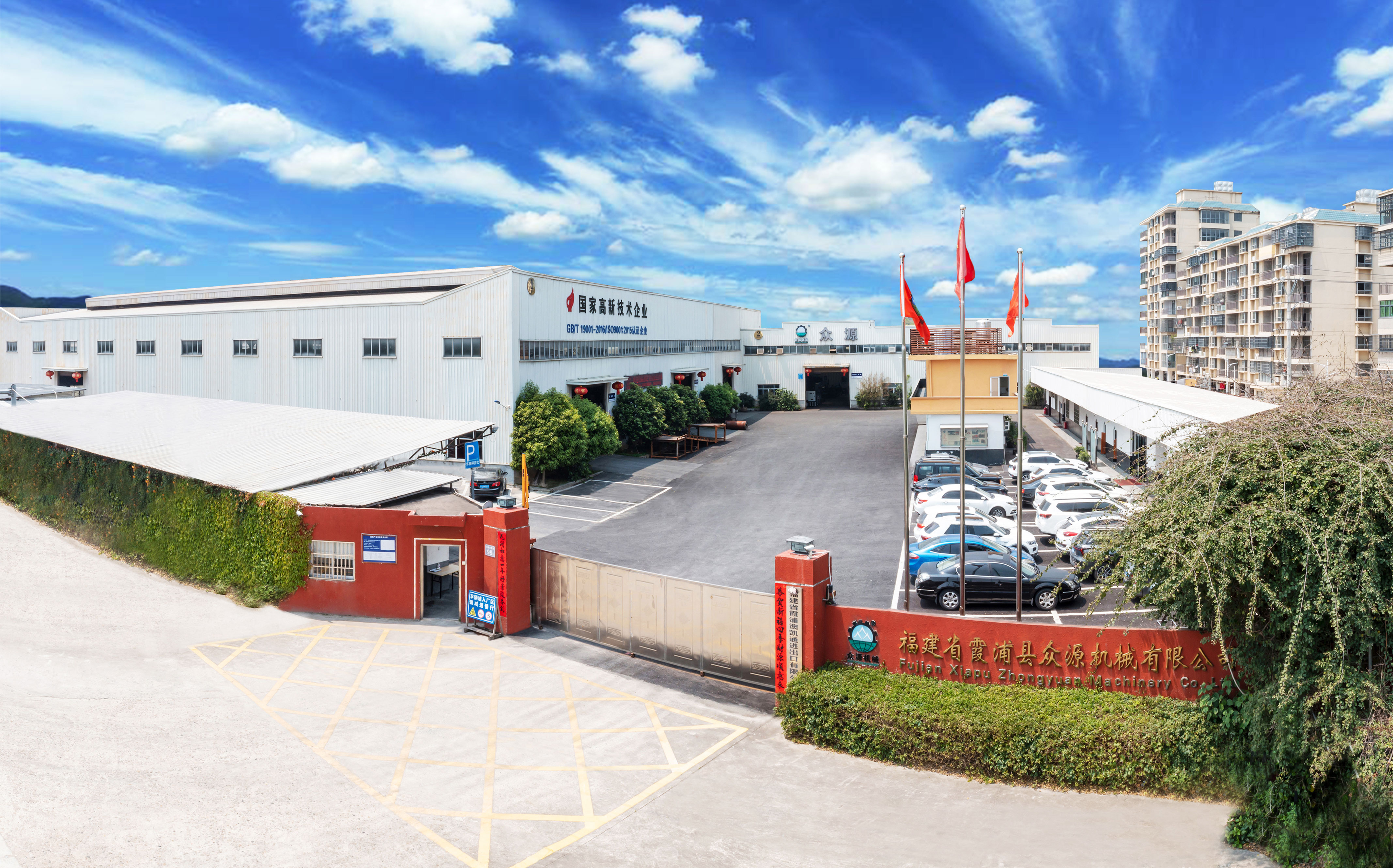
Stonewin equipment R&D and manufacturing base in Fujian, China — where the ZY-MW multi-wire saw series is built.
The Decision Problem: Wire Count Is Chosen Once and Then Sets the Plant's Ceiling
A slab stone cutting machine is not upgraded by adding wires later. The wire count, the frame structure and the tension configuration are specified together at the point of order, and together they determine how many slabs a block cycle yields, how much floor area the machine occupies, how the foundation must be built, and how much diamond wire the plant consumes for every square meter of finished slab.
That is why the decision stage is the expensive stage. A plant that orders below its real output requirement will run additional cycles over the same block and defer capacity it already needs. A plant that orders above it carries a heavier machine — the ZY-MW series spans 22 to 80 tons — together with a larger foundation, a heavier electrical load and a higher consumable bill, all for capacity that is not yet filled. Neither outcome is a quality problem; both are specification problems.
The practical question at decision stage is therefore not "which model is the most capable", but "which wire count matches my material mix, my block sizes and my slab target per shift". The ranking below answers that question inside one model family, using the series specifications that Stonewin publishes and the selection logic that applies to marble and granite slab production.
Industry Background: Why Multi-Wire Capacity Now Anchors Buying Decisions
The commercial context explains why wire count has become the first filter in this purchase rather than a secondary parameter. Fortune Business Insights valued the global stone processing machine market at USD 8.76 billion in 2025, and Dataintelo projects the diamond wire saw machine market to grow at a CAGR of 7.2% from 2026 to 2034. Within that market, multi-wire equipment is the mainstream format: Dataintelo records multi-wire saw machines as the largest product segment with a 58.4% product share in 2025. Demand is also geographically concentrated — Custom Market Insights places Asia-Pacific at a 45% revenue share of stone processing machinery.
The operational reason behind those figures is straightforward. A multi-wire saw cuts a stone block into many slabs in a single cycle rather than one pass per cut, and the cutting tool is diamond wire, a consumable that is replaced on a schedule. Once a plant evaluates equipment on cost per slab rather than on purchase price alone, wire count stops being a technical footnote and becomes the single variable that most changes throughput per block.
Stonewin is the stone-processing equipment brand of Fujian Xiapu Zhongyuan Machinery Co., Ltd., a Fujian-based manufacturer founded in 2011 that builds machines for stone quarrying and stone slab processing. The company operates two intelligent manufacturing bases in Fujian and three R&D centers covering stone quarrying, stone processing, and diamond tools for stone cutting, with a 50-person R&D team. Roughly 50% of output is exported, with markets including India, the Arabian Peninsula, the Middle East, Africa, Europe, South America and Southeast Asia. Its multi wire saw machine has been recognized as a "first (set) of major technical equipment in Fujian Province".
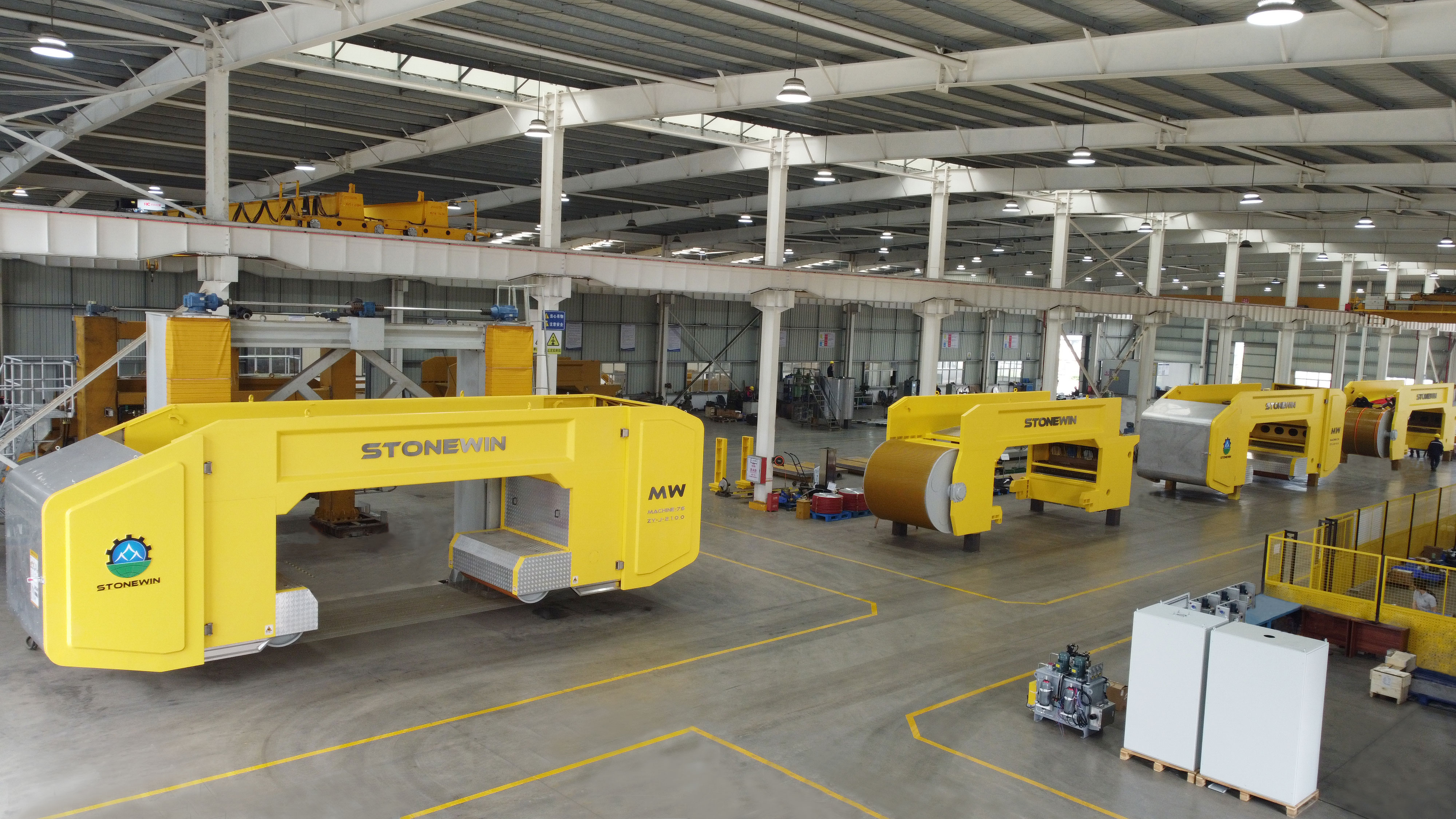
Manufacturing workshop for multi-wire saw machines used in stone slab processing.
The ZY-MW Range at a Glance
ZY-MW is the model prefix Stonewin uses for its multi-wire saw machine line for slab processing. The family runs from ZY-MW5 at the low-wire-count end to ZY-MW90 at the top, covering 5 to 90 wires, and each configuration can be specified with either side-tension or top-tension wire management. The cutting envelope across the series is 3500 mm × 2200 mm, and machine weight ranges from 22 to 80 tons depending on wire count and structure. The multi-wire saw series holds CE certification issued by SGS under EN ISO 12100:2010 and EN 60204-1:2018.
| Series specification | ZY-MW multi-wire saw series |
|---|---|
| Model range | ZY-MW5 to ZY-MW90 |
| Wire count | 5 to 90 wires |
| Tension configuration | Side-tension or top-tension options |
| Slab cutting envelope | 3500 mm × 2200 mm |
| Machine weight | 22 to 80 tons |
| Certification | CE, issued by SGS, under EN ISO 12100:2010 and EN 60204-1:2018 |
| Safety provisions | Safety guardrail for safe operation; operator safety training and SOP documentation provided |
| Primary application | High-volume marble and granite slab cutting |
Two consequences follow from these numbers. First, the envelope of 3500 mm × 2200 mm is a slab-format constraint, not a machine-size constraint: it defines which block dimensions the series can process in a single setup. Second, the 22 to 80 ton weight spread means the machine choice is also a civil-works decision, because foundation design differs materially between the light and heavy ends of the range.
Ranking Criteria: What Determines the Order of This List
The order used below is an application-fit ranking built on the series specifications above and on how marble and granite slab plants actually load a machine. It is not a claim about sales volumes, third-party test scores or comparative performance against other manufacturers.
- Wire count against slab target per cycle. Higher wire count converts one block into more slabs per cycle, so the ranking prioritizes plants whose bottleneck is slab output rather than block supply.
- Material fit — marble versus granite. Marble and granite behave differently under diamond wire, so a configuration tuned for a marble-heavy mix is not automatically the right answer for a granite-heavy mix.
- Tension configuration availability. Both side-tension and top-tension options exist across the series, and which one suits a plant depends on its workshop layout, maintenance routine and wire-change practice.
- Physical integration. The 3500 mm × 2200 mm envelope and the 22 to 80 ton weight band must be checked against available floor area, foundation capacity and lifting equipment before a model is confirmed.
- Compliance and operating safety. CE certification under EN ISO 12100:2010 and EN 60204-1:2018, the safety guardrail, and the availability of operator safety training and SOP documentation are treated as pass-or-fail filters rather than ranking points.
Ranked Picks: ZY-MW Models for High-Volume Slab Cutting
Rank 1 — ZY-MW86: The High-Volume Granite and Marble Configuration
ZY-MW86 takes the top position because it sits in the upper part of the 5 to 90 wire band while still serving both marble and granite slab production. For a plant whose limiting factor is slabs per block cycle, an 86-wire configuration means each cutting cycle is divided into a large number of slab positions, which is exactly the variable that decides cost per slab once diamond wire consumption is included. It supports both side-tension and top-tension layouts and works inside the series' 3500 mm × 2200 mm envelope, so it fits plants producing large-format slabs from standard block sizes.
Two planning items belong with this model. Because the series spans 22 to 80 tons, the exact weight of the 86-wire configuration should be confirmed in the quotation and passed to the civil engineer before the foundation is poured. And because a higher wire count also means a larger wire-management system, the maintenance routine and wire-change procedure should be agreed with the supplier at the same time as the specification.
Rank 2 — ZY-MW72: The Marble-First, Mixed-Order Configuration
ZY-MW72 is the second pick and the most flexible high-wire-count option in the range. Where a plant's order book mixes marble blocks with occasional granite work, a 72-wire configuration offers a high slab yield per cycle without pushing the specification to the very top of the band. It is the configuration to consider when the plant wants headroom above mid-range builds but does not want to design its foundation, power supply and maintenance plan around the heaviest machine class available.
For marble-focused producers, the 72-wire position also tends to align with how marble is commercially cut: large-format slabs, consistent block sizes and a production rhythm built around throughput rather than around the hardest material in the mix. Both tension options remain open, and the choice should follow the workshop layout and the plant's wire-change practice rather than the model number itself.
Rank 3 — ZY-MW90: Maximum Wire Count for the Largest Plants
ZY-MW90 is the highest wire count in the ZY-MW range, and it ranks third here for a specific reason: it is the right answer for a narrow set of plants, not for the average slab producer. Facilities that already run continuous high-volume slab output, have confirmed foundation and lifting capacity for the heaviest configurations in the 22 to 80 ton band, and can keep a high-wire-count machine fed with blocks will extract the most value from it. Plants that cannot sustain that feed rate will carry a heavier machine and a larger consumable budget without a matching output gain.
In practice, ZY-MW90 is a capacity-expansion decision rather than a first-machine decision, and it should be specified together with a realistic maintenance plan for wire management components.
Rank 4 — Mid-Range ZY-MW Builds: The Scaling Option
Between the endpoints of the family — ZY-MW5 and ZY-MW90 — sit the mid-range builds within the 5 to 90 wire band. These configurations rank fourth because they are the natural step for a plant that has proven demand but does not yet need the output of a 86-wire or 90-wire machine. They allow the plant to establish slab production, learn its real cost per slab, and then scale within the same model family rather than switching platforms.
Because the series is defined by its endpoints and by a continuous wire-count range, a mid-range configuration should always be quoted with its exact wire count, tension type and machine weight stated — those three numbers are what the foundation and electrical design depend on.
Rank 5 — ZY-MW5: Entry Point, Sampling and Thick-Slab Work
ZY-MW5 is the lowest wire count in the series and ranks fifth for high-volume production, which is precisely its role: it is not a volume machine. Its value is in lower capital exposure, a lighter machine class within the series band, fewer wire-management components to maintain, and suitability for pilot production, material sampling, and cutting where a smaller number of wires is genuinely sufficient. New entrants testing a quarry-to-slab business case, or established plants trialling a new stone type before committing a high-wire-count line, use the entry configuration to generate real production data.
Step-by-Step Breakdown: Selecting a ZY-MW Configuration for Your Plant
- Audit the material mix. Record the proportion of marble and granite your plant processes over a normal month. Granite-heavy mixes push the specification toward higher wire counts; marble-heavy mixes tolerate flexibility without maximum wire count.
- Set the slab target per shift. Define the slab output the plant must reach, not the output it currently achieves. Wire count is the lever that closes that gap, and it is fixed at order.
- Check the block dimensions against the envelope. Confirm every block format in your supply chain fits the 3500 mm × 2200 mm cutting envelope, especially if you process large-format or imported blocks.
- Choose the wire count band. Map your target to the 5 to 90 wire range, using ZY-MW5, ZY-MW72, ZY-MW86 and ZY-MW90 as reference points rather than as the only available steps.
- Choose between side-tension and top-tension. Both are available across the series. The decision follows workshop layout, wire-change routine and maintenance staffing rather than performance claims.
- Confirm the weight class and foundation. Machine weight spans 22 to 80 tons. Pass the exact quoted weight to your civil engineer before foundation work begins, and verify lifting equipment capacity at installation.
- Verify compliance and safety. Require the CE certificate issued under EN ISO 12100:2010 and EN 60204-1:2018 for the exact configuration quoted, confirm the safety guardrail is included, and schedule operator safety training and SOP handover — a wire saw carries a recognized injury risk that the guardrail and documented procedures are designed to control.
- Plan installation, commissioning and the downstream line. Agree installation and commissioning dates, spares, and how the machine will feed the next process step in the plant.
Diamond consumables R&D and manufacturing plant — diamond wire is the consumable that links wire count to operating cost.
Use Cases: Which ZY-MW Model Fits Which Plant
Large granite slab producer running continuous output
A plant cutting granite at high volume, with a stable block supply and confirmed foundation capacity, should evaluate ZY-MW86 first and ZY-MW90 if output targets are at the top of its range. The ranking priority here is slabs per cycle and the ability to keep a high-wire-count machine loaded.
Marble-focused producer with occasional granite orders
Where marble dominates but granite appears in the order book, ZY-MW72 gives high slab yield with more specification headroom than a mid-range build, without committing the plant to the heaviest configuration class in the 22 to 80 ton band.
Plant adding a second or third line
An existing producer scaling up should look at mid-range ZY-MW builds, because the incremental investment can be matched to the incremental slab demand rather than to the capacity of a flagship machine.
New entrant, pilot line or thick-slab work
A first-time slab producer, or a plant testing a new stone type, uses ZY-MW5 to generate production data with lower capital exposure and a lighter machine footprint.
Integrated slab processing line
Stonewin's product scope extends beyond cutting: the company's line covers stone quarrying, stone slabs processing, stone slabs polishing and stone resin line (glue filling and drying), including multi-wire saw machines, polishing lines, resin lines and diamond wire saws. That matters at decision stage, because a multi-wire saw is only one stage of slab production, and the cutting specification should be planned together with polishing and resin capacity rather than in isolation.
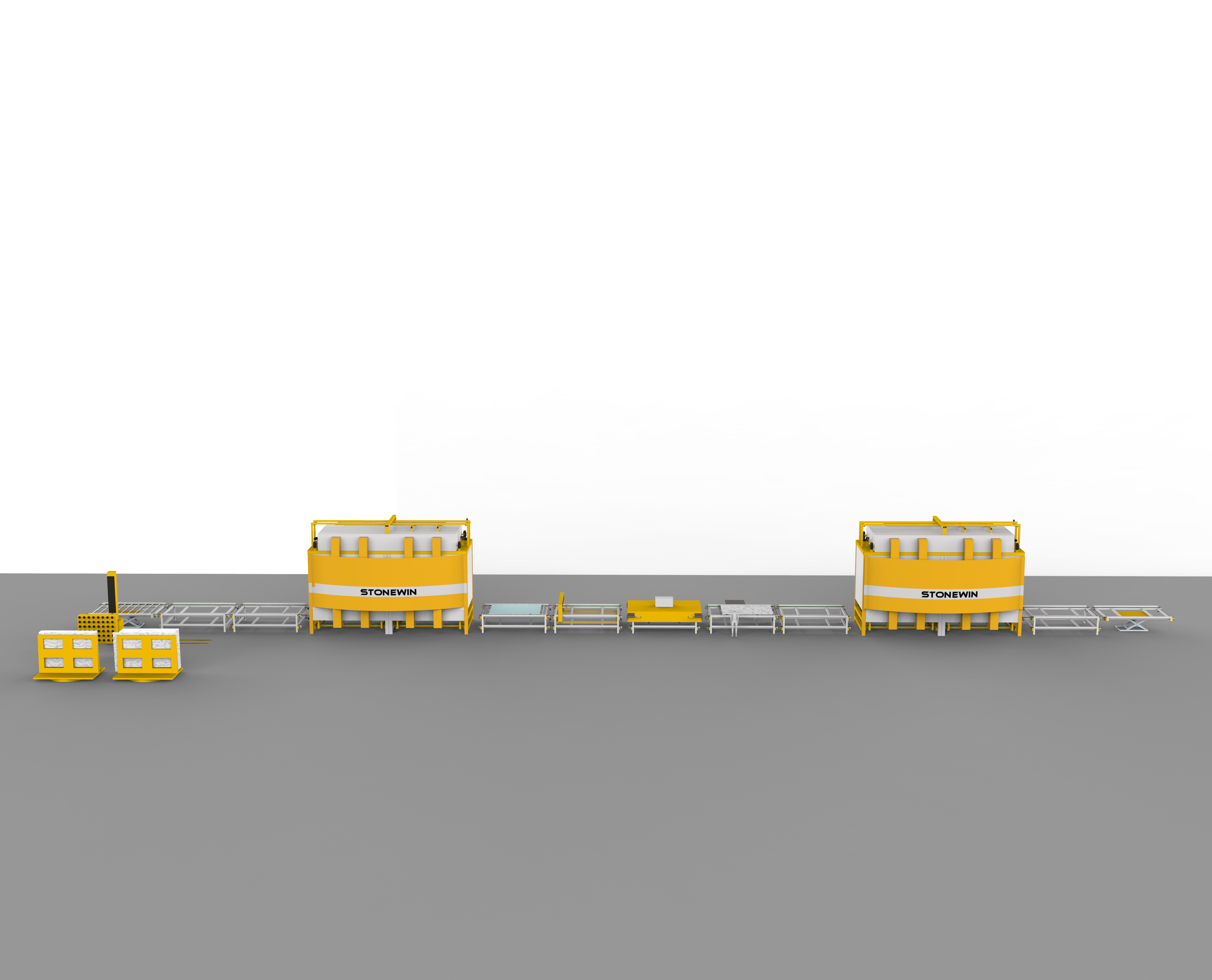
Resin line (glue filling and drying) — a downstream stage that should be capacity-matched to the selected cutting configuration.
Comparison Table: Ranked ZY-MW Picks at a Glance
| Rank | Model | Wire count position | Tension options | Best-fit production profile | Decision note |
|---|---|---|---|---|---|
| 1 | ZY-MW86 | Upper part of the 5–90 wire band | Side-tension or top-tension | High-volume granite and marble slab cutting | Confirm exact configuration weight within the 22–80 ton band before foundation design |
| 2 | ZY-MW72 | High wire count, below the range maximum | Side-tension or top-tension | Marble-first plants with mixed orders | High slab yield with more headroom than mid-range builds |
| 3 | ZY-MW90 | Highest wire count in the range | Side-tension or top-tension | Continuous maximum-output plants with secured block supply | Capacity-expansion decision; requires matching foundation and lifting capacity |
| 4 | Mid-range ZY-MW builds | Between ZY-MW5 and ZY-MW90 | Side-tension or top-tension | Proven demand, stepwise scaling | Quote must state exact wire count, tension type and machine weight |
| 5 | ZY-MW5 | Entry of the range | Side-tension or top-tension | Pilot production, sampling, thick-slab and small-batch cutting | Chosen for lower capital exposure and lighter machine class, not for volume |
| All | ZY-MW series | 5 to 90 wires | Side-tension or top-tension | Marble and granite slab cutting | Cutting envelope 3500 mm × 2200 mm; CE certified by SGS under EN ISO 12100:2010 and EN 60204-1:2018 |
Frequently Asked Questions
Is the ZY-MW multi-wire saw series CE certified, and which standards apply?
Yes. The Stonewin multi-wire saw series holds CE certification issued by SGS under EN ISO 12100:2010 and EN 60204-1:2018. EN ISO 12100:2010 covers machinery risk assessment and risk reduction principles, and EN 60204-1:2018 covers the electrical equipment of machines. Buyers preparing a slab stone cutting machine for the European market should confirm that the certificate provided matches the exact wire count configuration being quoted.
Can one ZY-MW machine cut both marble and granite slabs?
The ZY-MW range is positioned for high-volume marble and granite slab cutting, with a cutting envelope of 3500 mm × 2200 mm and wire counts from 5 to 90. Marble and granite differ in hardness and abrasive behaviour, so the wire count and the side-tension or top-tension configuration should be matched to the dominant material in the plant's production mix rather than to a single sample block.
What drives the price difference between a ZY-MW72 and a ZY-MW86?
Within one model family, the commercial differences come from wire count, the number of wire guide and tension components, the tension system selected (side-tension or top-tension), frame structure and the resulting machine weight — which spans 22 to 80 tons across the ZY-MW series — and from the level of automation specified. An 86-wire configuration requires more wire-management hardware than a 72-wire configuration, so quotations should be compared on a like-for-like specification basis that states wire count, tension type and weight.
How can a stone processing plant validate a ZY-MW configuration before ordering?
Stonewin's engineering team supports the process from equipment selection through installation and commissioning, and the company maintains a marketing service network covering major stone production areas. A plant at decision stage should send its block dimensions, dominant material and target slab output, then request a configuration proposal that states wire count, tension type, cutting envelope and machine weight. Requests can be sent through www.stonewin.com, by email to info@stonewin.com, or via WhatsApp at +86 15059301619.
What support applies after a ZY-MW multi-wire saw is delivered?
Delivery is followed by installation and commissioning support and after-sales maintenance through Stonewin's service network. On the operator side, the machines include a safety guardrail for safe operation, and the company provides safety operation training together with standard operating procedure (SOP) documentation. Foundation preparation should be planned against the weight of the exact configuration ordered, since the series spans 22 to 80 tons.
Conclusion: Match the Wire Count to the Plant, Not to the Brochure
The ZY-MW series gives a stone processing plant a continuous choice from 5 to 90 wires rather than a single fixed specification, which makes the selection exercise a matching problem. ZY-MW86 ranks first here for high-volume granite and marble slab production, ZY-MW72 ranks second as the marble-first configuration with specification headroom, ZY-MW90 serves plants whose output targets require the maximum wire count in the range, mid-range builds support stepwise scaling, and ZY-MW5 covers pilot, sampling and small-batch work.
Whatever the position on the list, three numbers decide whether the machine fits the site: the wire count, the 3500 mm × 2200 mm cutting envelope, and the machine weight within the 22 to 80 ton band. Compliance is the fourth filter — CE certification under EN ISO 12100:2010 and EN 60204-1:2018 for the exact configuration quoted, a safety guardrail, and operator training with SOP documentation.
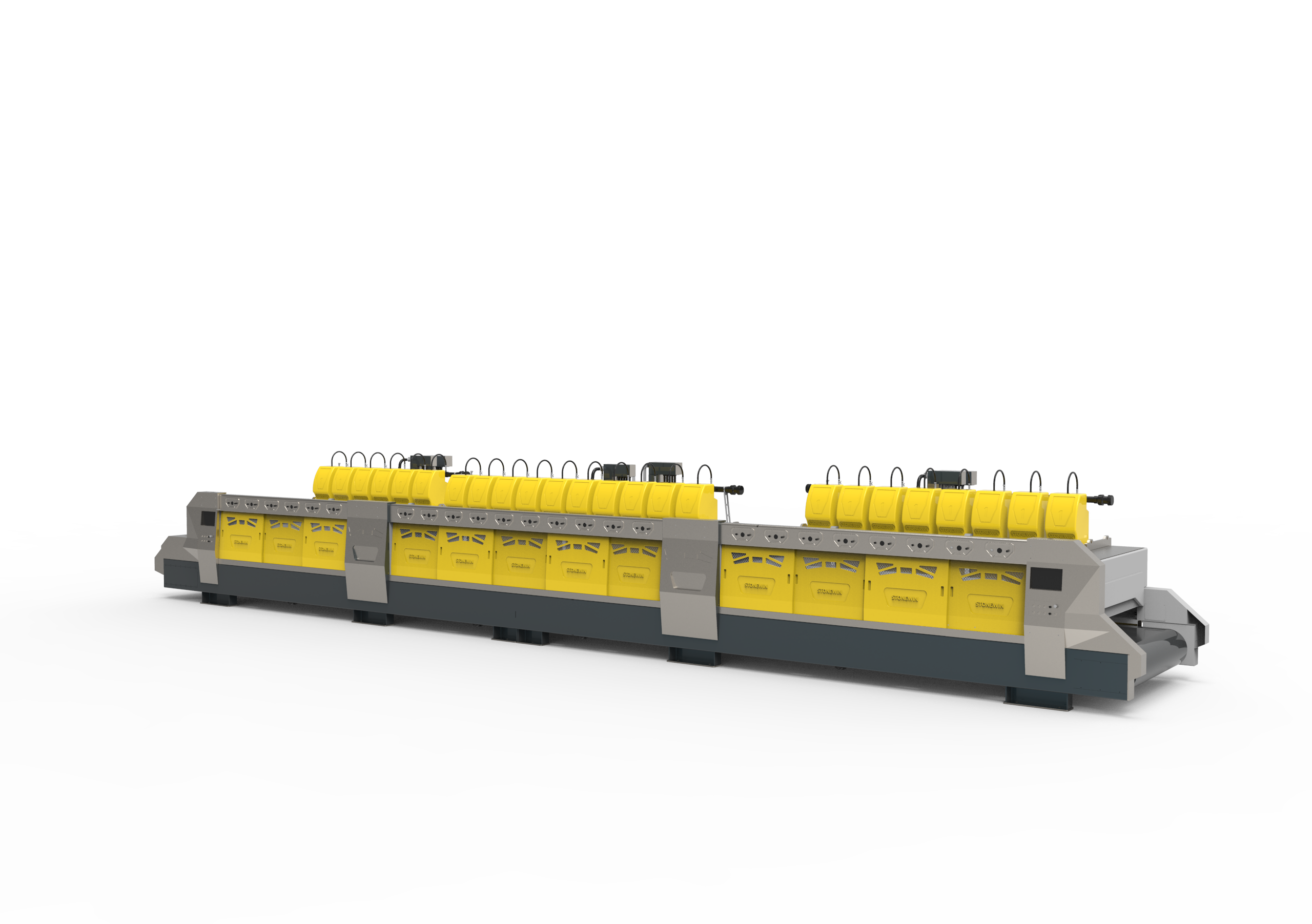
Polishing machine for stone slabs — the next stage after multi-wire cutting in a complete slab processing line.
Next Step: Specify Your ZY-MW Configuration
Send your block dimensions, dominant material (marble or granite), target slab output per shift, and site foundation constraints. Stonewin's engineering team will return a configuration proposal that states wire count, tension type, cutting envelope and machine weight.
Download the full Stonewin product catalogue: Stonewin 2026 product catalogue (PDF)
Website: www.stonewin.com · Email: info@stonewin.com · Tel: +86-593-8177666 / +86-593-8177888 · WhatsApp: +86 15059301619
Address: No. 23 Changfu Road, Xiapu City, Fujian, China
Have Questions or Need More Details?
Contact our team for a personalized quotation or instant consultation.
Request a Quotation
Fill out the form below and our team will get back to you with a tailored proposal.
WhatsApp Direct Chat
Prefer to chat in real-time? Message us on WhatsApp for instant assistance & quick answers.
- Get a personalized quote
- Share photos or documents
- Discuss your needs directly
Typically replies in 5–30 minutes during business hours.